Several lines on the menu: box size and weight ceilings set them apart
32 destinations get a real choice of lines. Two attributes in Tigbuy’s own data explain most of the difference between them.
Where the menu offers a real choice
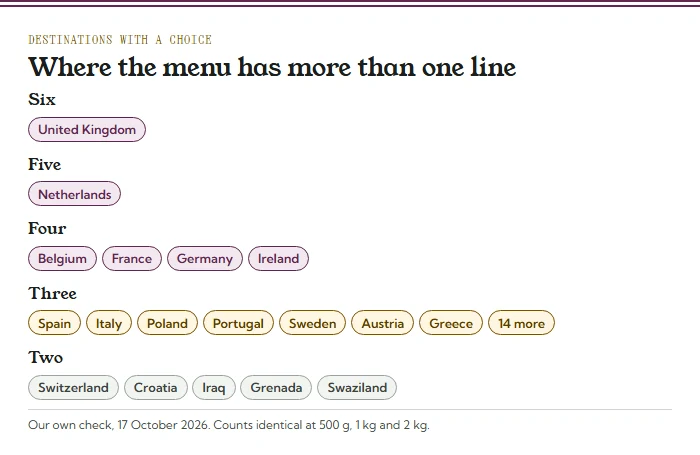
Thirty-two destinations get more than one line, and 27 of them are EU members. A typical EU menu holds three lines: the postal line, an SW standard line and a YT-OU-DHL-PY line. Belgium, France, Germany and Ireland add a second SW line, the Netherlands has three SW lines, and the United Kingdom has four, which is how it reaches six.
The five two-line menus are each odd in their own way. Switzerland has an SW line and the postal line. Croatia has SW and YT-OU-DHL-PY but no postal line. Iraq has the postal line and a YT-OU-DHL-PY line with a 30 kg ceiling, the highest we saw anywhere. Swaziland gets two SW lines and nothing else, an unusual menu for a southern African country. Grenada lists the postal line twice, with ceilings two grams apart, so in practice it has one.
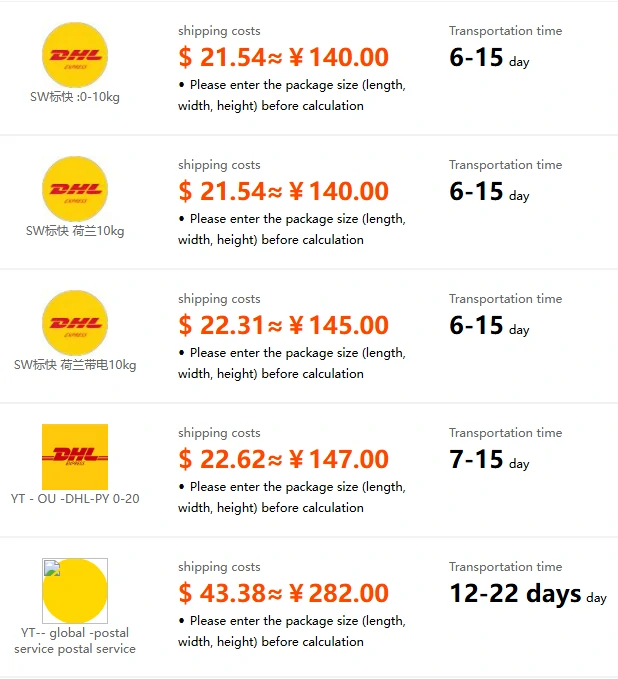
A five-line menu, as Tigbuy prints it
This is the Netherlands on Tigbuy’s result page for a 1,000 g parcel: three SW standard lines, then a YT-OU-DHL-PY line, then the postal line at the bottom. It is the second-longest menu in the estimator, after the United Kingdom’s six.
The three SW cards look almost identical. What separates them is not printed on the card: one bills on weight alone, one divides the box by 8,000, and the one meant for electric items divides it by 6,000. All three stop at 10 kg, which is why a 12 kg Dutch parcel is left with just two lines.
Read each card from the left. The round logo and the label under it name the line; the labels are Tigbuy’s own and mix English with Chinese, which is one reason this site talks about families rather than full line names. Next comes the quote in dollars and yuan, then the window: 6 to 15 days on the SW cards, 7 to 15 on the YT-OU-DHL-PY card and 12 to 22 days on the postal card.
Under every quote sits the same prompt asking for the package size before calculation. Here it matters: two of the five lines would bill a big box on its size, and the quotes on this page were made with a small box, so they reflect weight alone. The logo on the postal card did not load when we captured the page; the line itself was quoted normally. Nothing on the page marks any line as recommended.
The lookup card for the Netherlands sums all this up as five lines, two that bill by box size, a heaviest parcel of 20 kg and three lines kept by the Electric filter.
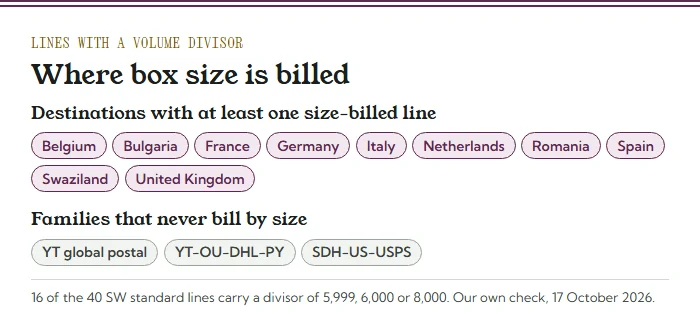
Box size, the attribute that changes the bill
Some lines bill on whichever is larger, the actual weight or a volume weight worked out from the box: multiply its three sides in centimetres, then divide by the line’s divisor. In the estimator’s data 16 of the 40 SW standard lines carry a divisor (5,999, 6,000 or 8,000), and they sit in 10 destinations. The postal, YT-OU-DHL-PY and US lines carry none.
Every SW line also carries a short note saying no volume charge applies. The server does not follow the note: where a divisor is set, the quote it returns is billed on the box. Plan with the divisor, and enter all three dimensions before you compare lines on these menus.
One parcel, two billed weights
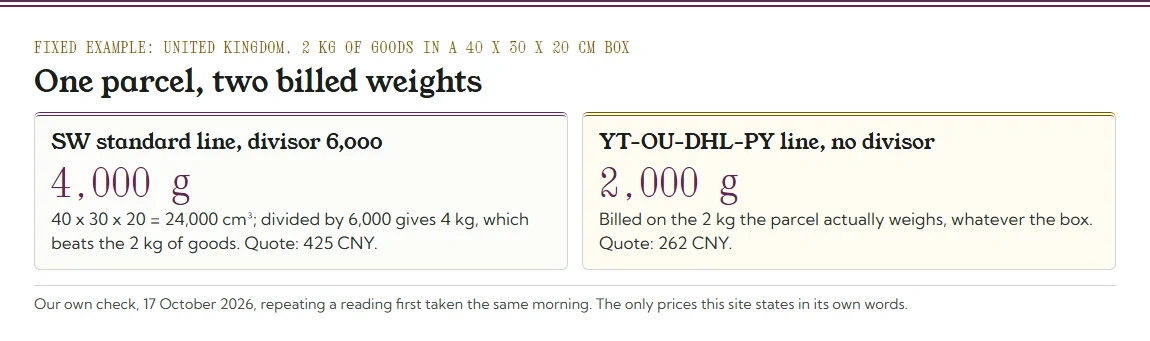
Take 2 kg of goods in a 40 x 30 x 20 cm box, sent to the United Kingdom. On the SW standard line with a 6,000 divisor the box works out at 4 kg, so the parcel is billed as 4,000 g and quoted at 425 CNY. On the YT-OU-DHL-PY line, which has no divisor, the same parcel is billed as 2,000 g and quoted at 262 CNY. Nothing about the goods changed; only the line did.
The same box at 1 kg in a 30 x 20 x 10 cm carton would have been billed on weight on both lines, because 6,000 cm³ divided by 6,000 is exactly 1 kg. That is why the menu counts on this site were taken with a small box: they show which lines exist, not which one costs least for your box.
Ceilings: which lines drop out first
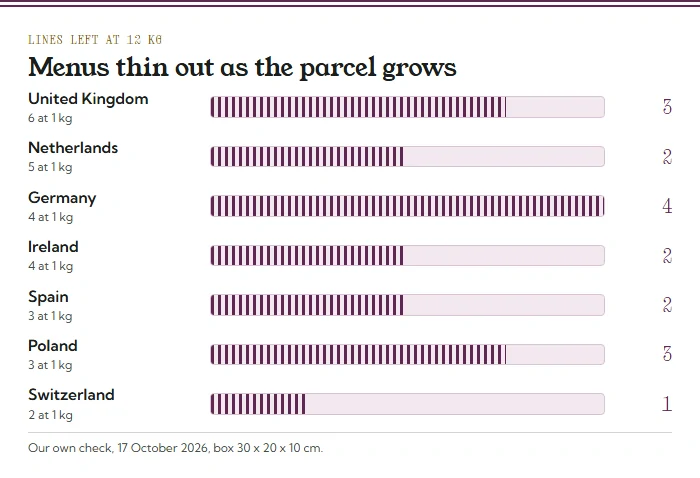
The second attribute is the ceiling. On these menus it runs from 2 kg to 30 kg, and as the parcel gets heavier the menu shrinks from the bottom. At 4 kg the United Kingdom loses its two electric-item lines, which stop at 3 kg. At 12 kg it is down to three lines, the Netherlands to two, Ireland and Belgium to two, Spain, Italy and Portugal to two.
Germany and France keep all four lines at 12 kg because both their SW lines go to 20 kg. Poland, Romania and Bulgaria keep three. Swaziland goes from two lines to one at 4 kg and to none at 12 kg. The weight ceilings page has the full set.
The United Kingdom shows how it happens. Its two electric-item lines stop at 3 kg and a third SW line at 10 kg, so a 12 kg parcel is left with one SW line, the YT-OU-DHL-PY line and the postal line. In the Netherlands all three SW lines stop at 10 kg, which is why that menu more than halves.
Electric items on a menu with choices
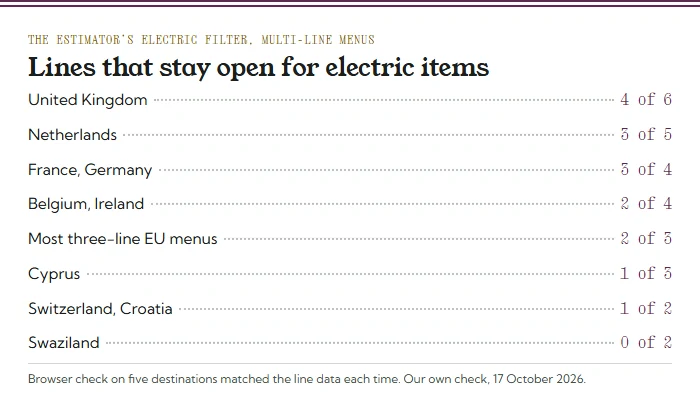
The estimator’s attribute box includes an Electric option. Set it and every line that does not take electric items gets a yellow notice bar under its card. On single-line menus it changes nothing, because the postal and US lines both stay open. On multi-line menus it removes most SW lines: only five of the forty are marked for electric items, in France, Germany, the Netherlands and the United Kingdom.
So a parcel with a power bank or a small gadget in it usually has fewer lines than the count suggests. The lookup card shows how many survive for each destination. Treat it as a first filter only: whether a particular battery or device can travel is still Tigbuy’s call when it sees the item.
Comparing lines without being told which is best
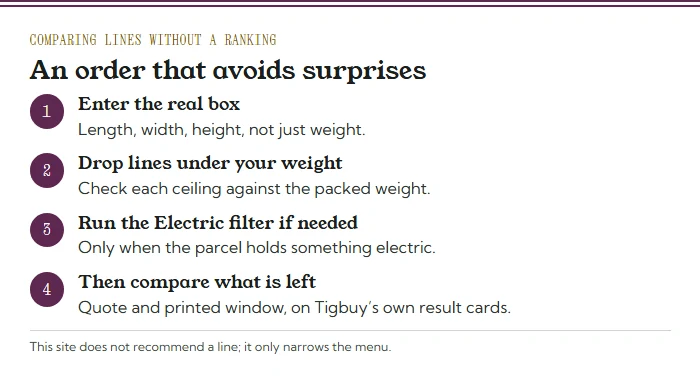
With the attributes in hand the comparison is short. Enter the real box first, because on a size-billed line the box can matter more than the goods. Strike out any line whose ceiling sits below your packed weight. If anything electric is going, run the Electric filter. Whatever is left is the real menu, and its quotes and printed windows are on Tigbuy’s result cards.
We do not rank what is left. Speed in practice, care in handling and how a carrier treats a parcel at your border are not things the estimator shows or this site can measure from outside.
If two lines are still standing after those steps, the decision is narrow: the same box and the same weight, with two quotes and two windows printed side by side by Tigbuy itself.